May German Studying Update

Another month another German update. I wrote an essay a couple weeks ago on "Time in Language" where I actually ended up changing my goals. At the start of April I set the following goals:
- Mine 105 words per week with Migaku
- Study 105 new words per week in Migaku Memory
- Keep up with my one lesson per week
- Keep up with my daily reviews in Anki and Migaku Memory
For the reasoning why I changed goals slightly, refer to the essay mentioned above. My new goals each week
- Immerse for one hour per day
- Study 105 new words per week in Migaku Memory
- Keep up with my reviews

The biggest change is to now immerse one hour per day, whether that be reading, watching series, speaking in a lesson, or listening to podcasts. I don't have an explicit goal for mining, but just that I'll need to mine enough *at some point* to have new cards to learn. I also dropped the German lesson from the goal list, but am still doing one per week. Doing them doesn't need to be a goal, but it still counts as immersion to talk to my tutor for an hour.
The biggest realisation is that I just need to get more volume in. Hence the goal of one hour per day. Honestly, this is definitely not enough to make fast progress. However, one hour that plus flashcard reviews adds up to about 90 minutes per day, which feels like a limit when I'm balancing this with a full-time job.
So how did I do relative to my goals for this month? I'll use the old ones as the benchmark since those are what I was working with most of the month.
Mining 105 cards per week. I met this most weeks, but in the last couple of weeks did not. This was partly because I realised this is probably not a goal I want to stick with. I was also travelling at the end of April, so didn't mine as much anyway.
Learning 105 new words per week. I met this goal every week. I had enough backlog built up in mined cards that I was able to keep up the 15 words per day.
The content I watched this month started as I planned last month. One final season of How to Sell Drugs Online (Fast) (HTSDOF) came out. I also planned to watch the latest episodes of Sakamoto Days that came out. HTSDOF is 6 episodes, and there were about 5 Sakamoto Days episodes released. This was about 3 hours of HTSDOF and 2 hours of Sakamoto Days. I got through both in about half a week.
So I had the rest of the month's worth of video content to fill in. I watched a lot of food bloggers on Youtube. I found Randy Gamble's food blog videos really nice. For Youtube, I actually started a separate account to watch German content on. For my main account, I just wasn't getting recommended much German content. For the new one it is not perfect (still a lot of English videos), but it is much better. I do find on my new account recommended German videos to add to my watch later list. Definitely a no-brainer to set up a separate account for language immersion.
Like I discussed in my recent essay, I want to be more comfortable doing passive immersion even when I don't really follow the conversation well. When I've been struggling to reach my one hour immersion due to a long day of other tasks, I've been throwing a podcast on while commuting. My podcast of choice has been the Swiss Pioneers Podcast. The interviews are a mixed bag but at it's best the guests and conversation are super interesting. When possible, I've sometimes downloaded the transcipt and followed along while listening. This really improves my comprehension.
On Netflix I started watching Dark. It is more challenging than other shows I've watched, but I can follow the thread OK. It is a bit creepy, so I don't really want to watch it late at night. But after a couple episodes so far, I plan to keep up with it and make it my main Netflix show in May. I've also just started rewatching the first season of HTSDOF.
Occasionally I've been watching easier content (say food bloggers) without subs. I have mentioned in a previous update how subs are kind of a crutch for my understanding, so I think occasionally doing no subs will allow me to push my listening skills and train my brain to focus on the audio, since sometimes I do notice myself focusing much more on the German subs.
For flashcards, I kind of kept up with reviews. I did all my Migaku reviews every day, since I do them before new cards. For my legacy Anki cards, I didn't review every day while I travelled. I did however, check in just enough that I don't have a huge backlog. I think in the next two weeks of commuting I'll be back to 0 backlog with Anki.
Books. Last month I mentioned trying to read more. From the limited reading I've done, it does seem like a much more effective way to load on vocab, since the words per minute is just much much higher than a TV series. I am pretty set that I don't want to read stuff I find boring. So I started with Neruomancer. I am actually concurrently reading the English version. Honestly, it is just a bit too hard. I read most of the first chapter in German, after reading it first in English. So I knew on the macro-level what was happening, but even then I was getting lost on the sentence level. It is both a difficult book, and had a lot of genre-specific words that I'm unlikely to have picked up from elsewhere. I like the book a lot though and it's a goal for me to come back to it once I get a bit more confortable with reading. I've just not done much reading before, so it is a real slog getting through the harder material. I think partly I just need to get more comfortable with reading in German itself, rather than necessarily get more vocabulary onboard. The biggest component of this is overcoming the disomfort of not understanding everything. By reading more, I hope that I can work on this feeling.
In the last couple of days, I tried switching to Harry Potter and the Sorcerer's Stone. You can tell that I'm very set on not reading some dull graded reader, but stories that I'm actually interested in. I got my soul taken by the first page of Harry Potter a few months ago. However, so far I'm nearing the end of the first chapter and I'm actually finding it manageable. I get tired pretty quickly but I'm able to keep progressing. I don't follow every line, but I follow enough to not be completely lost. In contrast, in Neuromancer there were occasionally whole paragraphs where I was mostly lost. I'm going to try and stick it out with Harry Potter, because I think I can actually do it at my level. The plan is to build confidence there and, then challenge Neuromancer again when I'm done.
I'm reading Harry Potter with just the text, in Migaku Reader. With Neuromancer, I tried playing the German audiobook at the same time. I only tried that for two sessions, but it didn't go that great. The audio was just a bit too fast for me and I felt like I was rushing the text. I'd usually pause after every couple of paragraphs to go back and reread the text more closely. While that was kind of tough, I think this idea has potential if I finetune it a bit. I have not tried audiobooks on 75% speed, but if it doesn't sound too unnatural, I might try this idea again. Having the audio too feels kind of like free listening practice.
The next month my goals are exactly the revised ones I wrote earlier in the post. For accountability, I've joined a small thread on the Migaku Discord where I post how I met my hour of immersion each day, and a plan for the next day. I don't alwasy follow the plan. For example for today I wrote that I would rewatch and episode of HTSDOF, but I ended up watching a German Pokemon Lets Play on Youtube instead, that was recommended on the front page of my new account. The plan is more like a nice backup. Like, if nothing changes, here is what I am going to do. I've been posting updates there for about 10 days and plan to continue. It's a great accountability device to be giving updates surrounded by some very dedicated language learners.
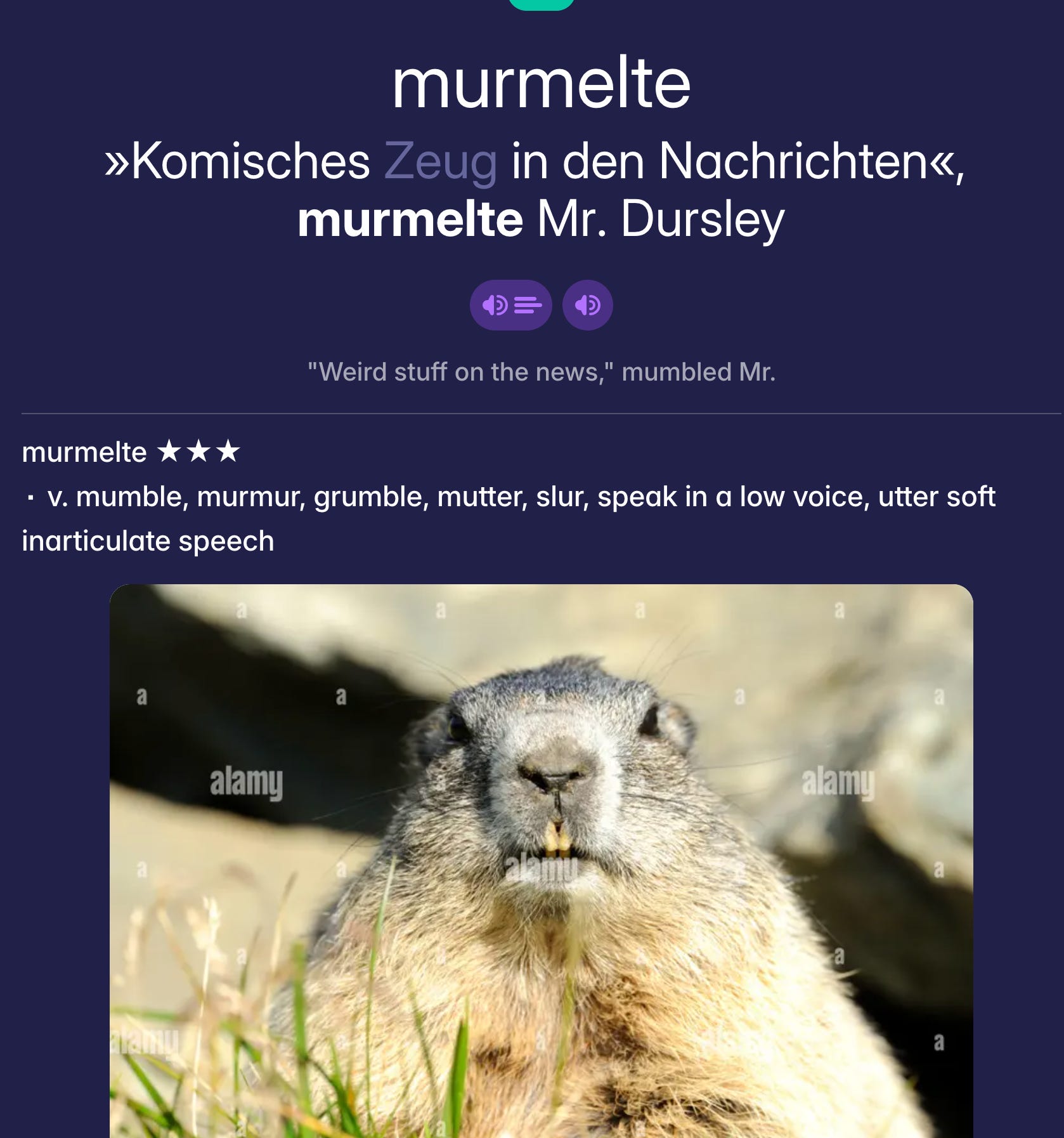
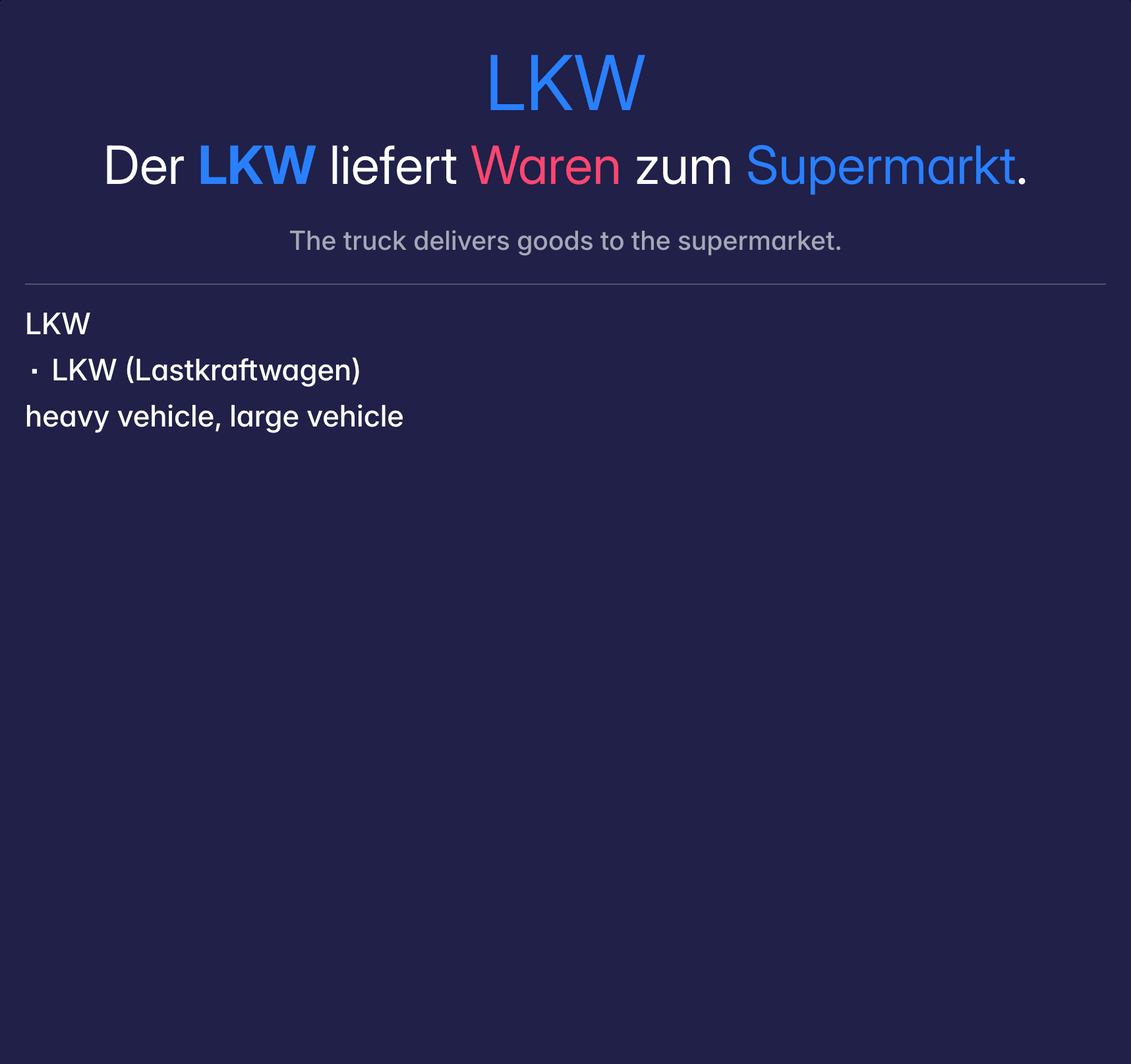
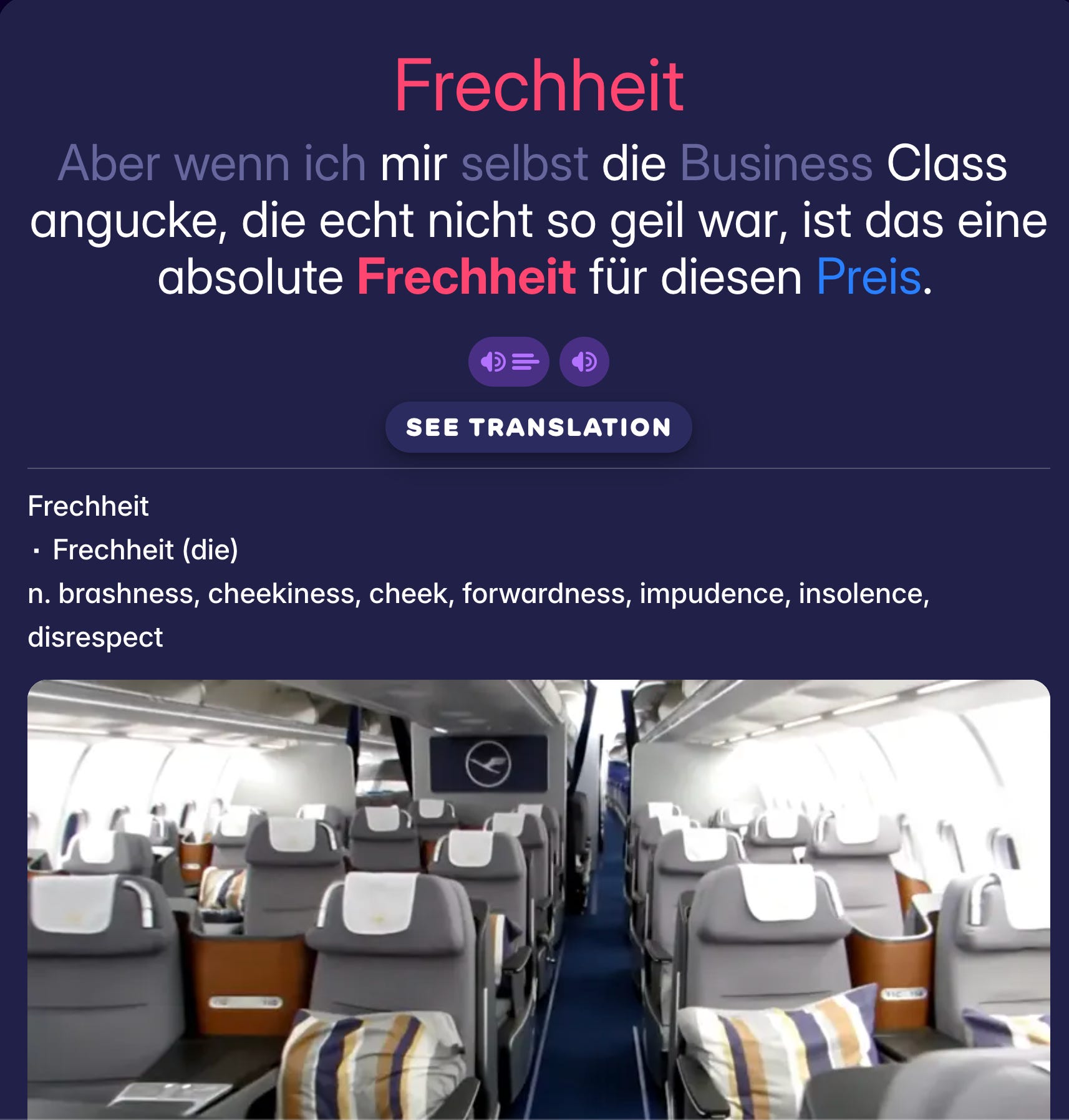
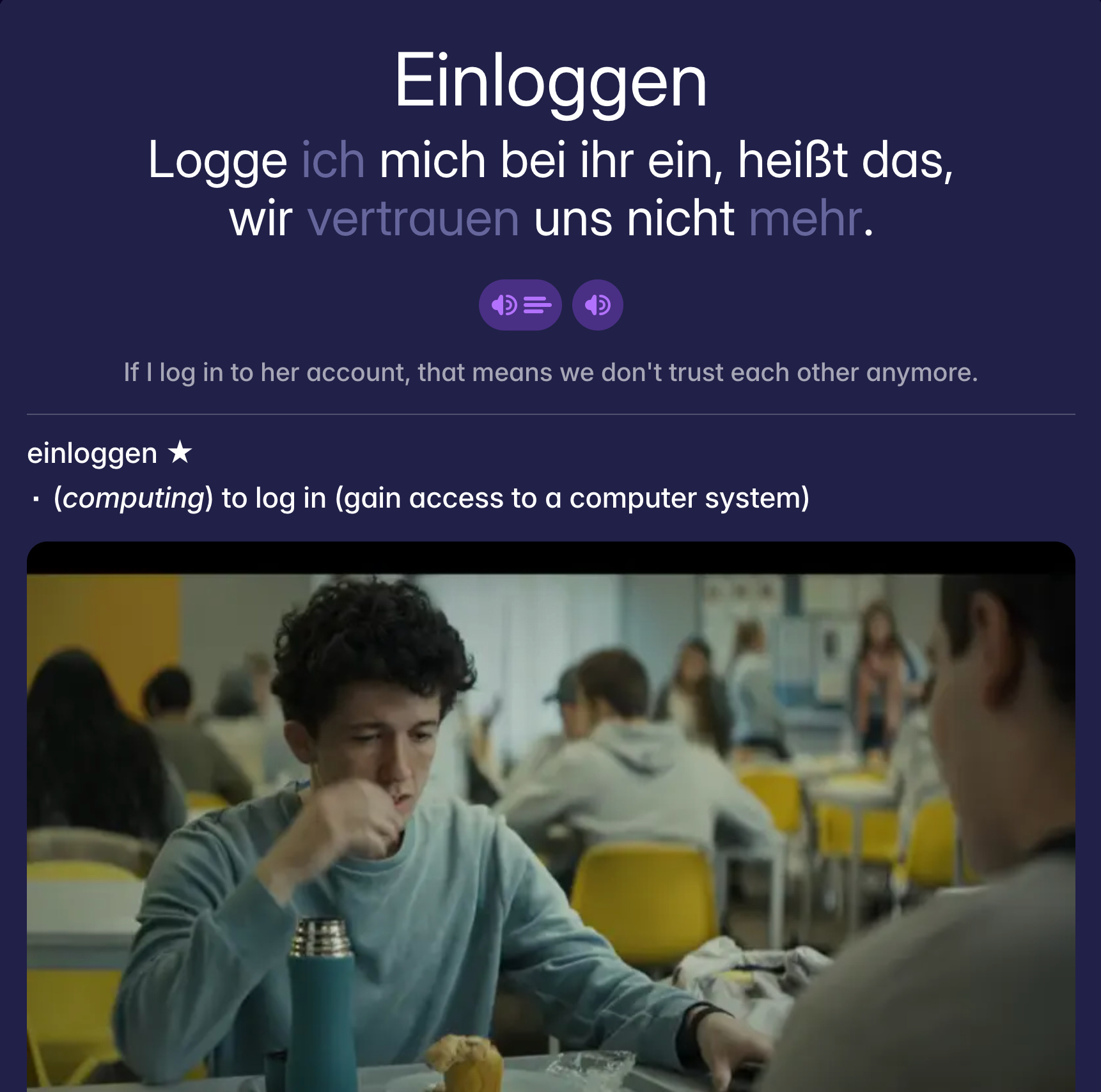
I’ve added here a few screenshots of Migaku cards I’ve made this month for any interested readers. I’ve picked these out semi-randomly just to give a sense of the kind of cards I’m mining. Featuring some cursed Migaku autogenerated images for the text-only cards
From Harry Potter chapter one:
A word I noted down in a German lesson and later had ChatGPT generate an example sentence for:
From a Youtube video someone made about flying to America to start a roudtrip:
From an episode one rewatch of HTSDOF. Sometimes with separable verbs in German you need to manually modify the card so that you don’t just end up mining, ‘loggen’, which is not going to give you a definition which makes sense for this sentence.
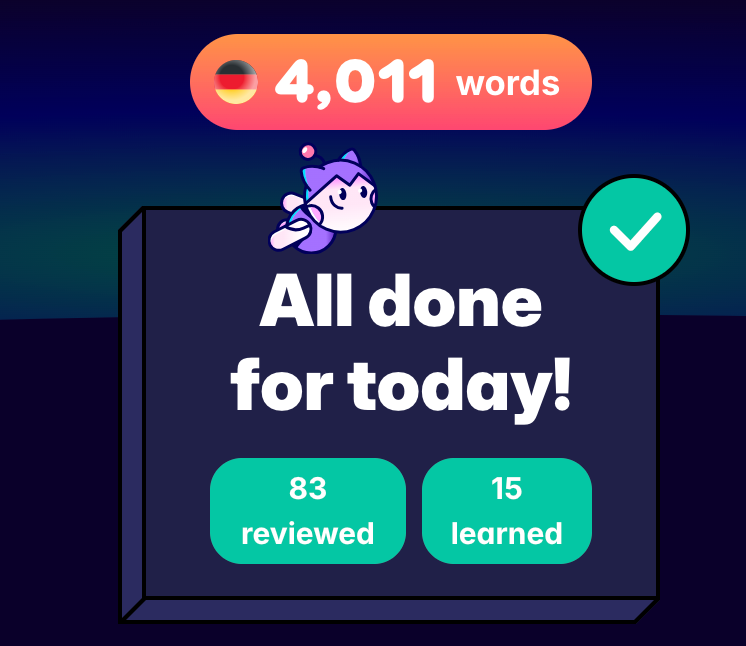
And finally, a round number: 4000 known words in Migaku!