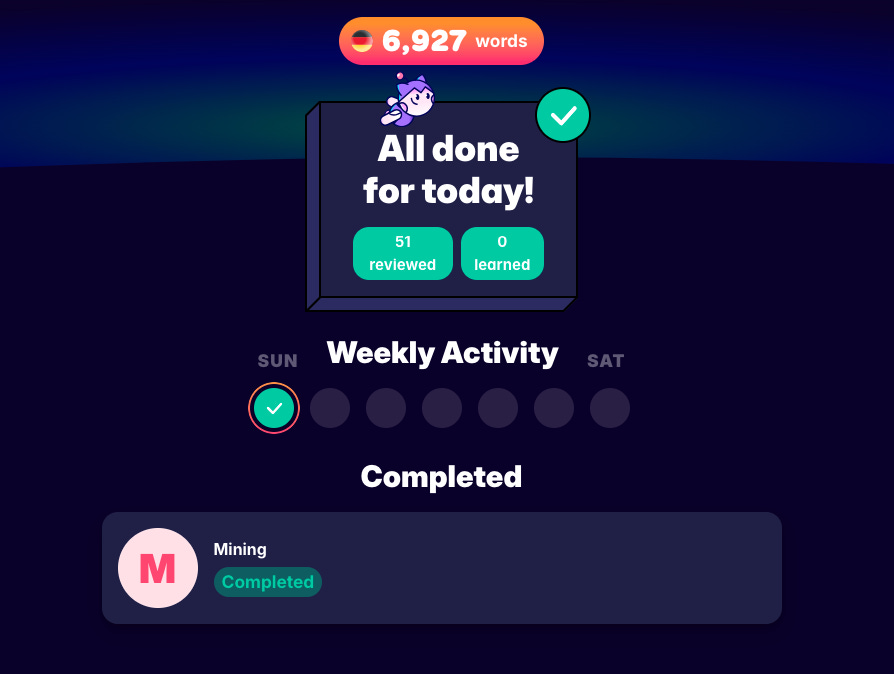
August German Studying Update
A change of priorities

Another late month update! I’ve continued to stick with my main goals of immersing every day. But this month has been marked by a bit of frustration and a feeling that I need to change my approach.
If you recall, my goals for last month were to keep up my streak on Migaku and to immerse for an hour a day. I’ve been posting my updates daily on Twitter, which has been a great accountability device. I think I only missed my one-hour-a-day goal once this month, so my consistency has been good. I'm currently on a 17 day streak of at least one hour per day of immersion.
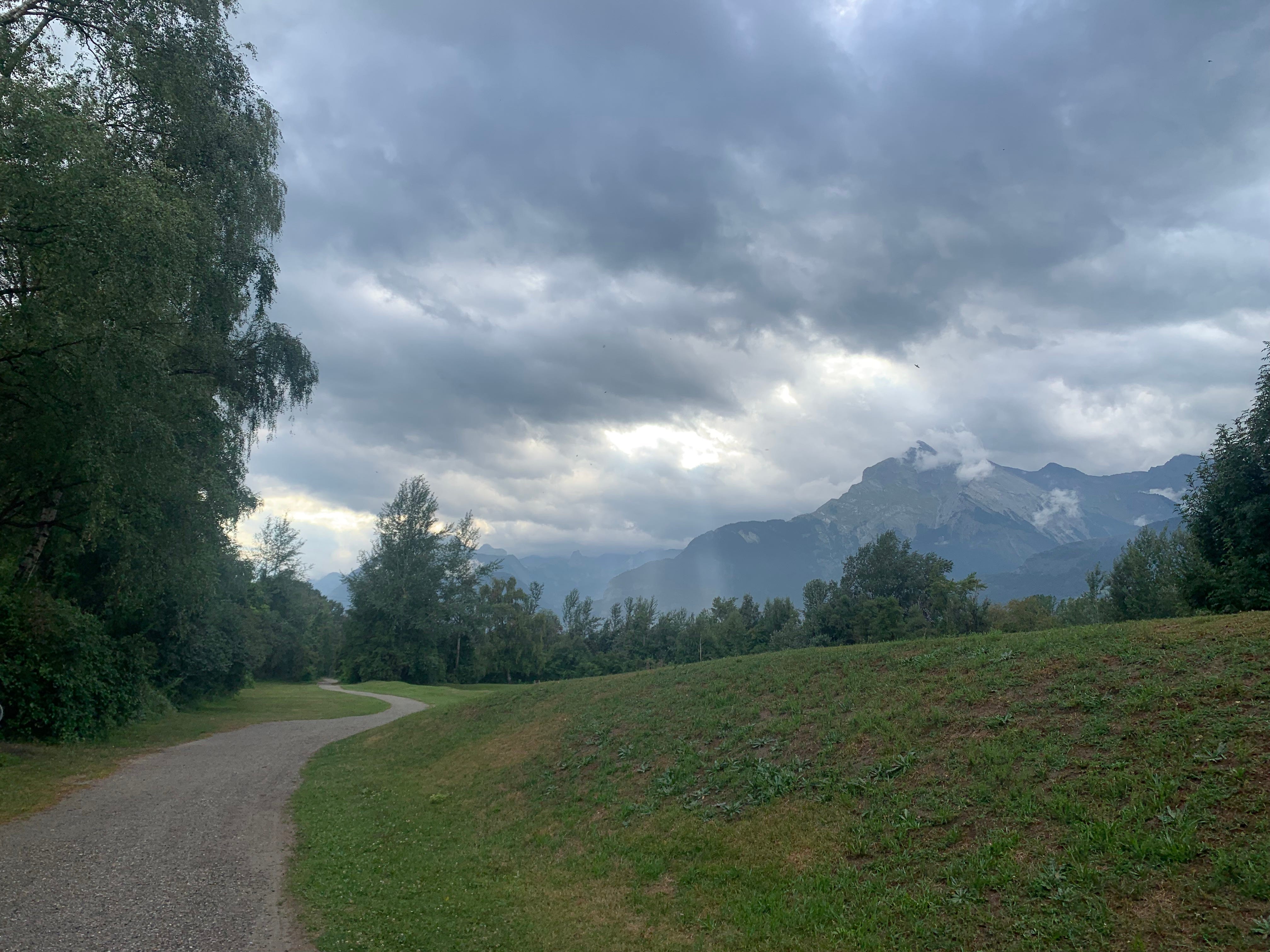
However, I've not been seeing the practical progress in day-to-day life. I continue to get better at comprehending dubbed animes and German reality shows, but now that I'm spending more time in Switzerland, this isn't enough to feel satisfied. I go to events and find myself frustrated with my inability to output. Moreover, even though my comprehension is good when watching TV, those shows often have quite clear voices and a standard dialect. Often when I'm out and about, the accent is stronger, there's more people talking, and there's often a lot of Swiss German dialect in the mix. On all of these points, my comprehension drops massively. This is almost expected, since I've spent very little time putting active practice in with comprehending the Swiss dialect, besides a bit of TV watching. I feel I’m getting to a point where I'm a bit impatient, and I want to press on. Instead of just building up my vocabulary and my comprehension of High German, I want to start making some gains that will better reflect my day-to-day life here. These two points are output and Swiss German comprehension.
A Major Roadblock and a Point of Reflection: The Migaku Parser
These two points may seem like a big pivot, especially when I'd been all-in on vocab acquisition and comprehension. I even was targetting getting to 10k known words in Migaku. A big part of this pivot was my increasing in-person interaction in the language, and realising that I want to be able to use the language more right now in my day-to-day. Another part of this realization was a roadblock that limited my ability to continue on the path I'd previously set.
The Migaku app’s German parsing has, sometime in the past month, I think, completely broken. Even some much more advanced users have stopped mining completely. The app became effectively unusable for making new cards, though it's still fine for doing reviews. For those who don't use Migaku, I'll try to give an explanation. The parser tries to take words you haven't marked as known, and highlight them in the text so you can make a flashcard from them. Recently, the parser often detects words as completely different words. For example, it will often misinterpret nouns as a much less commonly used verb form. This means that you have a flood of words highlighted, 95% of which you either already know or are being parsed to a completely different word. Unfortunately, it seems that many beginners have not really noticed this, and there doesn't seem to be much of an effort to make the issue well known. Personally, I can't see how anybody could use the app for mining in this state without getting flashcards for words that aren't even in the sentence being mined, which amounts to completely erroneous flashcards. It's unfortunate that this issue has persisted for quite a while now, but the Migaku team is excellent. I've heard that they are actively working on it, and I have no doubt that when a solution is ready, I'll be back to mining again and going towards my 10k known words goal.
I've spent less time on German this month. I've kept up my hour a day and my card reviews, but I haven't actually been making new ones. I'm sort of holding out some trust that it will just get fixed because the switching costs to Anki are quite high. More relevant to this update, the issue has also made me question if the 10,000-word goal is really what I should be going for in this exact moment. I think it makes sense to build this vocab out for sure, but I also think it makes sense to spend some time starting to reap the rewards of my existing work.
Shifting Focus: From Passive to Active
I’m going to keep my one-hour minimum goal but reconstruct how I spend the time. I think I'm doing quite passive stuff—watching shows, listening to podcasts, occasionally reading—and I can probably get more bang for my buck by doing more conscious, active tasks. This means focusing on two key areas: output and Swiss German comprehension.
Improving My Output
My output is definitely worse than it was a few months ago when I was taking lessons. I know a lot of the different grammar structures and can recognize them, but I struggle a lot with actually forming sentences on the fly, which is a different skill.
My plan to address this is:
- **Get a Tutor:** I'm going back to Preply to hire a tutor. I think just paying someone to talk to me is the best way to keep a rigid structure. I'll aim for **three sessions a week**. I might even try some 30-minute sessions, as I get tired quite quickly during the hour-long ones I typically do. I mostly want a conversation partner who can correct me, which usually means you can get a better price than if you need a full-on tutor as total beginner. Tutoring can sometimes be difficult to schedule since I can't just do it whenver, and need an internet connection. I'm planning to schedule sessions for weekday mornings before I leave for work.
- **Grammar Workbook:** I'm going to work through a grammar workbook on my commute to practice forming sentences.
- **Daily Writing:** A simple but effective idea somebody recommended is to write a few sentences each day. I'll add this to my daily routine after my card reviews—write a minimum of three sentences and get them checked with ChatGPT for errors.
- **Mine My Own Conversations:** When Migaku is fixed, I might ask my tutors if I can record our calls and use those transcripts for mining.
Hiring a tutor is pretty expensive, even with the wealth of online options now available. Studying grammar is also not the most fun thing in the world. The medium term goal is really to practice these things in my real life context. So writing in German for my own thoughts, and speaking German out and about. Living in a German-speaking country is a huge advantage that I don't take full advantage of. However, I often find myself talking a bit less, just because I'm so hampered with actually forming a semi-comprehensible output. The goal with the tutoring and the grammar study, is to push my output ability up as quickly as possible, so that I use German more in my day-to-day life. The hope is that with a couple months pushing, I can spark a reaction that will have me using German a whole lot more and enjoying outputting in the language. No more just sitting and passively following the conversation at parties, but really joining in and expressing myself.
Tackling Swiss German Comprehension
I’ve put almost no effort into this so far, even though I often talk about eventually doing it.
My plan here is:
- **Swiss German Media:** I'll try to shift some of my media consumption towards Swiss German content. This is hard because there isn't an "Easy German" equivalent that is straightforward to comprehend, and I'll pick up a lot less, but it's something I need to start doing if I ever want to get comfortable comprehending the dialect.
- **Workbook:** I've seen some "German to Swiss German" books in the bookstore here. I'll buy one this week and start working through it to pick up some vocab and easy sentences.
- **Basic intro videos:** I noticed that easygerman have some basic videos just covering some of the most common vocabulary differences. I'll work through these just to expose myself to some of the key differences to get me started.
- **Tutor:** I’ll look for a tutor who can speak Swiss German or help me transition over to understanding it.
I'll see what the tutor recommends, but an initial idea is for me to output standard German, and to ask the tutor to output in Swiss German, or some mix that I'd be able to follow well-enough to get the conversation going.
I don't have plans to try and output in the dialect. It would be an amazing outcome if I can just output standard German and comprehend if the other person uses a Swiss German dialect.
Immersion and Flashcard Update
My immersion content this month has been:
- **Netflix:** I've been watching some *Sakamoto Days* and I finished episode 45 of *Pokémon Horizons*, which is the most recently released episode of the German dub.
- **Podcasts:** A lot of *Easy German* (I'm on about episode 70 now) and a little bit of the *Kaulitz Hills* podcast.
- **Other:** A very small amount of YouTube, watching sports on TV with German commentary, and occasional social interaction where people are speaking German around me.
Social interaction in German occurs maybe once every two weeks at some kind of event.
I’m starting to lose a bit of interest in some sources because they feel like learning materials. I don’t know if I would have listened to 70 episodes of an equivalent show to Easy German in English so quickly, even though I do enjoy it and plan to continue listening while I'm on the go. I'd love to read things like *Neuromancer* or other scifi novels in German, but I think the level is still too high for now. I just end up doing lookups too often.
As for flashcards, my Anki backlog is massive. The plan to just do it in big bursts hasn't happened. I need to be stricter. I have kept up with my Migaku Memory reviews religiously, however.
Up Next: My New Plan
Here are my concrete goals for the coming month:
- **Keep the Streak:** Continue with a minimum of one hour of German per day and post my daily accountability updates on Twitter.
- **Clear the Cards:** Every day on my commute, I will do my Migaku reviews **and** 50 Anki reviews to start clearing the backlog.
- **Daily Writing:** Write and get corrections for a minimum of three sentences every day.
- **Structured Weekly Plan:**
- **Tutoring:** Three sessions per week.
- **Active Study:** On three of my commute days, I will work on my grammar and Swiss German workbooks.
- **Passive Immersion:** On the other two commute days, I'll keep doing what I'm doing with shows on Netflix.
I listen to podcasts (read: Easy German) usually while just walking between places.
I'm going to switch to these goals immediately. So my day today is going to include booking some Preply sessions, doing my first three sentence writing session, and dusting off the grammar book to put it in my work bag. The one-hour goal was always a minimum, and I think with this new plan, I'll be going well over an hour on some days, which is good. It’s time to push things a bit. Until next month!
Current known word count: 6900